
SERVICES
Marketing Transformation
Do you connect with customers effectively, and have systems that support it?
A buyer lands on your website, reads your message, calls your team. In those few minutes everything counts: whether the brand makes sense, whether the message answers their problem, whether the person who picks up knows what the last person promised.
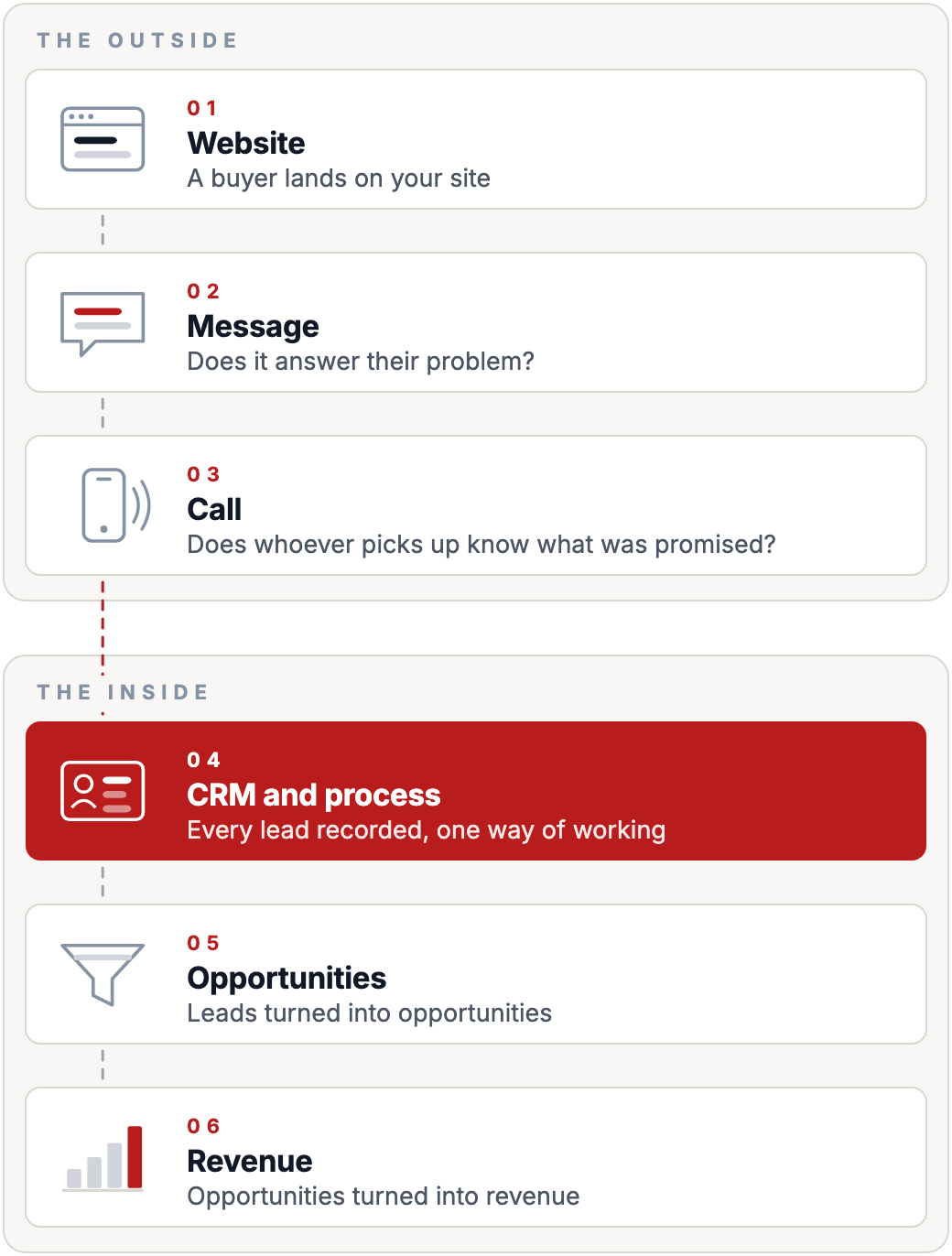
That’s the outside. The inside is what makes it possible — the technology and processes that turn leads into opportunities and opportunities into revenue.
Marketing transformation changes both. It starts with an honest look at what’s working, what isn’t, and where the business is working harder than it needs to.
Why companies get stuck
- Ineffective brand messaging. It describes what the company does instead of how it solves the buyer’s problem. What’s in it for them never comes up.
- A poor customer experience. No CRM, no process. Every salesperson tells prospects something different, and nothing is recorded.
- No data. Nobody knows which work produces business and which just produces activity.
- Disconnected processes. The website, the forms and the sales team each run on their own, and leads fall through the gaps.
- Vendors holding the company hostage. The websites, tracking and accounts sit with outside vendors who charge what they like and control what the company can change.
- No innovation. Without data every new idea looks like a risk, so this year looks like last year.
How I work

Analysis first. Before recommending a tool, a rebrand or a process, I find out what the company already has, what people actually use, and what each piece produces.
One thing at a time. Adoption has a curve. Hand a team an entirely new tool set and they go back to what they know. Roll out one change, let it settle, then the next.
Keep what’s working. If people like a tool, it stays, even if the integration isn’t perfect. You don’t rip everything out because part of it doesn’t work.
What this looks like
ELB Learning
Six acquisitions had left one company running as seven brands. I co-led the rebrand to ELB Learning: booth visitors up 50%, web traffic up 33%, and $10M → $50M.

Goldson Construction
No CRM, no analytics, no process — salespeople told prospects different things, with no record of any of it. I brought the websites and CRM in-house, cutting website costs 97%, and kept the tool the team already liked, KonstructIQ, rather than replacing it — its quotes will move into the CRM by email. Next is the brand. A 63% bounce rate from Construction to Glazing shows the two look like unrelated companies; one master brand rolls out soon.

Find your lane forward.
Tell me where you’re stuck. I’ll start by finding out what’s already working.